
Jon Bjarnason
Cognitive Performance Expert · Speed Reading Master Trainer
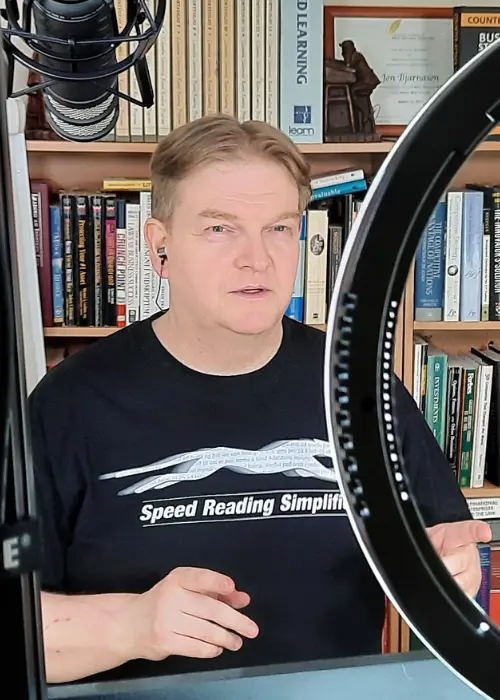
Cognitive Performance Expert and Speed Reading Master Trainer. For more than 21 years I have trained people to read faster, focus longer, retain more, and think clearly under heavy information load — over 19,000 students, from children of seven to a reader of ninety-four, across live workshops, corporate training, one-to-one coaching, and online courses. Founder of Speed Reading Simplified and owner of Hraðlestrarskólinn, Iceland's leading speed reading school, founded in 1978. I still teach the courses myself — from the student deciding where to begin to the executive who reads for a living.
I did not set out to do this. I went to university to become a corporate lawyer. The method I teach was not copied from a book or franchised from someone else's brand — I inherited a course with a real lineage and rebuilt it, over two decades, one student at a time, testing it against a wider range of real readers than almost anyone in this field will ever meet. That is the part no competitor can copy. Not the technique. The time in the chair.
Here is how I got here, because the story explains the method better than any list of credentials could.
How a corporate-law student became a reading teacher
In 2001, at thirty, I decided to become a corporate lawyer. For years before that I had run a business with my wife. I had taken over a company the previous owner had let stagnate, and within a year it had six times the cashflow, far more customers, and very high customer satisfaction. By every measure I could see, it was working. And yet I kept running into cashflow problems I could not explain, and I could not work out why.
One Saturday morning I took my two young children to the library. While they browsed the children’s section, I wandered the non-fiction shelves, still turning that business problem over in my head. One book sat askew, not pushed all the way into the row. I reached to straighten it, and the title stopped my hand. I opened it — and on the exact page I had opened to was the answer to the problem I had been carrying for months.
What I understood in that aisle was simple and it changed my life: I was struggling in business because I was not reading enough. Almost every problem you will ever face, someone has already lived through and written a book about. Reading had quietly become a luxury I had stopped affording myself — between the work and two small children, it had slipped away. That had to change.
That Christmas I asked my wife for Robert Kiyosaki’s Rich Dad Poor Dad, which had just been translated into Icelandic. Reading it, I did not fall in love with becoming the rich dad. I fell in love with being one of his advisors. So I applied to Bifröst University to study corporate law, and moved the family onto campus.
Then reality arrived. Law is a mountain of reading. And around the same time, my son was diagnosed with dyslexia. Sitting in the therapist’s office, listening to her describe his reading, my own childhood came flooding back — every struggle I had never had a name for. I said it out loud: everything you are finding in him might be true of me too. She tested me. I was dyslexic. It explained a great deal — and it meant I was about to begin a reading-heavy law degree as a dyslexic adult, and I was going to need help.
I remembered Hraðlestrarskólinn. I had taken its speed reading course at seventeen, thirteen years earlier — half-heartedly, more for my parents than for myself. The school ran its courses in Reykjavík, ninety minutes from campus: three hours of driving, once a week, for six weeks. I had no appetite for that. So I called the owner and asked him to come teach at Bifröst instead. He was willing, but he needed thirty students — and, he told me, he had tried for years to start a course at Bifröst and had never once managed to fill one.
That afternoon I wrote a single careful, genuinely useful email and sent it to the whole student body. By that evening, thirty-two students had signed up. I called the owner back the next day: I have thirty-two, when can you come. There was a pause, and then he said, “Who are you?” What he had failed to do in years, a student had done in an evening. The truth is it was an easier sell for me — I was not a salesman pitching them, I was a peer asking them to do it with me.
That course split my university years cleanly in two: before speed reading, and after. I had always been willing to do the work. Now I had the capacity to match the willingness, and it changed everything — including, to my surprise, my time. I got more done and had more of my life back: more hours with my wife and children, fewer evenings with my nose buried in a textbook.
The guidance counsellor noticed, and asked me to become a Student Helper — advising students who were struggling. I had the time now, so I said yes. And that is where a shy, fairly timid man discovered he might be a good teacher. The irony was not lost on me: a year earlier, that same counsellor had given me a personality assessment that said I should become a teacher, and I had rejected it flatly. I was there to be a lawyer. But helping other students taught me the one thing that makes a teacher: you only understand something properly once you are forced to explain it to someone else. I became a far better student by teaching.
In my final year I had time to spare, and I saw that Hraðlestrarskólinn was for sale — a school founded in 1978, by then twenty-five years old. I knew exactly what its course had done for me, and I knew I wanted to do that for other people. I called the owner and asked if he remembered me from three years before. “Of course,” he said. “How could I not.” We met, we shook hands, and in 2005 I became the school’s owner.
I bought it as a side business — something to run alongside a law career at the big banks in Reykjavík. That was the honest plan at the time. What I did not know was that within a year it would stop being the side of anything. I read Jay Conrad Levinson’s Guerrilla Marketing and used it to rebuild the school from the ground up, and within six months I was running four to six live courses a month, twenty to thirty students in each. Somewhere in those months I realised I loved this — teaching people to read more, read better, and fall back in love with books — in a way I had never once felt about the law. The work turned out to be the kind you would happily do for nothing; it still feels faintly improper to be paid for it. The law career I had planned simply never happened. Twenty-one years later I am still here, still in the room, still enjoying every minute of watching a reader rediscover books. The side business that was never supposed to become my life became my life’s work.
What I inherited, and what I rebuilt
When I bought Hraðlestrarskólinn, I inherited a method with a genuine lineage. Its founder had trained in the United States in the Evelyn Wood Reading Dynamics tradition — the most famous name in twentieth-century speed reading — and had translated and taught that material in Iceland for more than twenty-five years. I respected it. But I also knew its weaknesses, because I had felt them as a student, and because the field that produced it is the same field responsible for most of the inflated claims that make people, rightly, sceptical of speed reading today.
So I rebuilt it. I added proper diagnostics, so a reader could see where they actually stood instead of guessing. I went through every component and kept only what I could ground in cognitive science — if I could not explain why something worked, I stopped teaching it. I moved the centre of gravity away from raw speed and toward comprehension and retention, because speed without understanding is not reading. And I added the study technique that turns faster reading into better results in real work and study. What I teach today shares its ancestry with that 1950s tradition the way a modern car shares ancestry with the first ones off the line. The lineage is real. So is the distance travelled.
Why I know this is a skill, not a gift
The most common thing people believe about fast, effective reading is that it is a talent — something you are either born with or you are not. I know from the inside that this is wrong, because I was not born with it. I am dyslexic. But for most of my life I had no idea, and the reason I had no idea is worth telling, because it overturns almost everything people assume about what dyslexia looks like.
I was not a child who hated books. I was the opposite. I inherited a large library of children's and teenage books my father had been given — his parents and grandparents had been diligent about keeping books in front of him — and I reaped the reward of it. My own grandparents kept the tradition going: every Christmas and most birthdays, another book, because they were sure I loved reading. And I did love it. I read every one of them. Books were my best friends growing up; I lived in their story worlds. The catch, which I could not have named at the time, was how. The books took me a very long time to get through, and from about nine until nearly eleven I spent days reading aloud in my room, because reading aloud felt more real to me than reading silently. When my grandparents asked me how a book was, I could always answer, and the answer was true. I had read it. It had just cost me far more than it cost anyone else.
Fiction hid the problem, because a story pulls you through — the narrative does some of the work, and I could remember a novel almost page by page. Where the difficulty lived was in textbooks and non-fiction: material with no storyline to carry me, just masses of information that simply would not register. That is where the trouble grew, quietly, year after year, until at nineteen I called it quits, left school, and went to find a job. I did not try again until I was thirty.
The last thing that kept it hidden was spelling — the very signal that catches dyslexia in most children. I always scored high marks for spelling, so no one looked further. What no one knew, including me, was that I had built a private workaround: I articulated each word to myself to remember exactly how it was spelled, letter by letter. I still do it. The voice in my head pronounces words as they are spelled while I write. It is why I had no name for any of this until I was a grown man in a therapist's office, listening to her describe my son's reading, and heard my own childhood coming back to me word for word.
I did not inherit a gift for reading and lose it. I never had one. I built the skill, deliberately, as an adult who badly needed it — and then I spent two decades learning to teach it to other people, including dyslexic students who had been told the very thing I once believed about myself. The grandparents who kept giving me books never knew they were building the one skill that would later save me.
This matters for one practical reason. If a reading method only works for people who are already good readers, it is not a method — it is a sorting mechanism. Mine had to work for someone like me first. That is why I trust it for everyone else. The boy who could only get through a book by reading it aloud, slowly, now reads several in a day. If that distance can be closed for me, it can be closed for almost anyone.
What I teach: a system, not a bag of tricks
I teach an integrated system, and the distinction is not cosmetic. Techniques produce temporary results when the conditions happen to be right. A system produces results that compound and last. Everything I teach lives inside what I call The Speed Reading Simplified Methodology™ — The SRS Method™ for short — and it covers five connected territories: speed acquisition, comprehension development, active reading, structured recall, and the habit architecture that makes the whole thing permanent rather than a weekend's improvement that fades by Friday.
The starting point is a single idea that, once you see it, you cannot unsee: reading is not a fixed trait. It is a trainable cognitive performance skill. Most adults are stuck reading at roughly the speed they reached as children, because the act of decoding words became automatic somewhere around the age of eight and was simply never retrained afterwards. I call this the Assumed Skill problem: we treat reading as finished business, a skill we completed in primary school, when in fact most people stopped developing it the moment it became good enough to get by. The eyes are not the bottleneck — they already take in three to four words at a glance. The bottleneck is rhythm. And rhythm can be trained.
The honest, research-consistent outcome I stand behind: most students move from somewhere between 150 and 300 words per minute to roughly 400 to 600 words per minute, with equal or better comprehension, inside four to eight weeks of short daily practice. I do not promise the inflated figures the speed reading industry is famous for. I have deliberately stripped those claims out of everything I publish. The realistic result is more than good enough to change how you work and study — and it is true, which the larger numbers usually are not.
The foundational exercise is the one I teach in the first session of every course and coaching programme, and the one I wrote up in my book, Speed Reading Simplified for Beginners, available on Amazon. Beyond the foundations, the method includes a structured recall system for holding what you read — the Cognitive Recall System — and a body of work I call the 21 Habits of Highly Skilled Readers. I name these here rather than teach them; the actual training is what the courses, the kit, and the coaching are for. What matters on this page is that they exist, that they connect, and that they were built in a real classroom rather than assembled from theory.
The same method is delivered at the depth each reader needs. Most people use the self-directed materials — the Starter Kit and the online courses — and get everything they require from them. Some want it run live, with the pace calibrated to them. And for high-responsibility professionals — executives, founders, lawyers, anyone whose work is reading and whose decisions depend on what they take in under pressure — there is High-Performance Reading (HPR): the same core method, delivered as deep one-to-one coaching and reframed around cognitive performance rather than reading speed. HPR is about measurable improvement under information load — faster, more accurate decisions, less rereading, lower cognitive fatigue, stronger synthesis and judgement. It is the deeper route for the reader who needs more than a course can give. Most people do not; some do, and they know who they are.
Hraðlestrarskólinn and twenty-one years in the classroom
Hraðlestrarskólinn is Iceland's leading speed reading school. Founded in 1978, it delivers the complete programme in Icelandic to Icelandic students and corporate clients. Speed Reading Simplified is the English-language brand that brings the same method, and the same person behind it, to readers everywhere else.
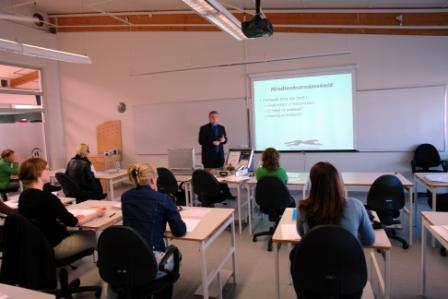
Across those twenty-one years I have taught the full range of what a human reader can be: children of seven and a reader of ninety-four; janitors and bank directors and police officers; secondary and university students drowning in their reading loads; and professionals in law, medicine, finance, and executive leadership, where the volume you can read directly determines the leverage you have. That range is not a vanity statistic. It is the reason the method is robust. It has been stress-tested against more genuine human variability than most people who write about reading will ever encounter — and the parts that did not survive contact with real students were discarded years ago.
I have been a guest on Icelandic radio and television and a sought-after speaker at company and institutional seminars, and over the years my students' results have been covered in Iceland's national newspapers, Morgunblaðið and Fréttablaðið — among them the team from Menntaskólinn í Reykjavík who took the course and then won Gettu betur, Iceland's televised national academic championship. But the work I am proudest of is the ordinary, repeated work: a student who arrives convinced they are simply a slow reader, and leaves knowing they were never the problem — the operating system was, and it can be upgraded.
What students say
I began a Master’s degree abroad and was shaken by the sheer volume of reading. I found Jon’s one-to-one coaching online, and we built a schedule around my exact needs. In no time I had tripled my reading speed — in English, which is not my first language. Study texts that used to take me more than four hours now take closer to one. My only regret is not doing this years earlier.
— Katrin, 39, Master’s student
“I need to read a great deal in my work, and this course let me get through it faster and better than before.”
Atli Tor Kristbergsson
IT manager
“It surprised me how much you can increase your reading speed — a simple way to raise your productivity at work.”
Audbjorg Olafsdottir
Economist
“I can recommend this to anyone who has to get through an immense amount of information quickly while keeping strong comprehension. It also gave me back time for myself and the people I care about.”
Aldis Arna Tryggvadottir
Stock analyst
Is speed reading real, or is it a myth?
Won't I lose comprehension if I read faster?
I've always been a slow reader — can that actually change?
Can you learn to read faster if you're dyslexic?
What's a realistic reading speed — and what counts as "fast"?
Does this work for dense or technical material, or just easy reading?
Isn't speed reading just skimming?
Do I need a course or coach, or can I do this myself?
Where to start
If you have read this far, you are probably wondering whether any of this applies to you. The honest answer is that I do not know yet — and neither do you. That is what the diagnostic is for.
The 5-Minute SRS Reading Diagnostic is not a words-per-minute speed test. (If you only want your raw number, that is what the reading speed test linked above is for.) It asks a short set of questions about how you actually read — your focus, what you retain, how your comprehension holds, and how you cope when the reading load climbs — and it shows you, on the spot, which of four reader profiles fits you and what is most likely holding you back. Then it names a clear next step for your profile. For most people that step is the Starter Kit, not coaching — and the diagnostic will tell you so plainly, because that is the truth for most people.
You do not have to give an email address to see your result. If you choose to leave one, you will get a note from me — written by hand, to you, not pushed out by an automated sequence. It takes five minutes, it is free, and it is the right first step whether or not you ever do anything else with me.
A short note on who I am, in case you skipped the story above: twenty-one years teaching, more than 19,000 students from age seven to ninety-four, owner of Iceland’s leading speed reading school, author of Speed Reading Simplified for Beginners, and someone who is dyslexic himself and built this skill from the wrong end of it. That is the whole basis on which I am asking for your next five minutes.
Take the 5-Minute SRS Reading Diagnostic