
The 5-Minute SRS Reading Diagnostic™ - A Reading Skills Assessment & Diagnostic Test
Find your reading profile in five minutes — and see exactly what to do next.
The Four Reader Profiles
Your answers across the twelve diagnostic questions produce a cumulative reading-friction score that places you in one of four reader profiles. Each profile describes a recognisable relationship with reading, and each receives a different recommended next step. The profiles do not measure intelligence or reading capability in the abstract — they describe how your current reading system is performing against the load you are asking it to carry.

The Steady Reader
Your reading is in good working order. Friction signals across the diagnostic are mild — focus is steady, retention is reasonable, and the reading load you face feels manageable. This is a meaningful place to be reading from, and most readers do not get there without deliberate effort. The right next step is the free Speed Reading Simplified resources, where small habit refinements produce disproportionate gains.

The Pressured Reader
Your reading is functional, but the pressure is starting to show. Moderate friction in places where it matters — focus that slips on dense material, retention that fades within a week, the slow growth of unread material you genuinely meant to get to. This is the most common profile of people who finish the diagnostic. The right next step is the SRS Starter Kit, a structured ten-day course that installs the foundation reading habits in the order they actually need to be built.

The Strained Reader
Your reading is under real strain. Substantial friction in several places that compound on each other — focus collapse on demanding material, retention loss within a week, reading load that has cost you something specific recently. This is the profile where structured intervention produces the most visible change in the shortest time. The right next step is one of the SRS coaching programmes — the 6-week Executive Coaching Program for most readers in this profile, or the 30-Day Standard Coaching Program as a lighter starting point.

The Overloaded Reader
Your reading is significantly overloaded. High friction across most of the dimensions the diagnostic measures — frequent regression, focus that collapses before you can finish dense material, poor retention, fatigue, articulation difficulty, an unread pile beyond what you can track. You are not a poor reader. You are reading on a system that was never designed for the load it is now carrying. The right next step is the 6-week Executive Coaching Programme, specifically built for readers in this profile. For executives, business owners, and founders operating at a level where reading is core to professional performance, the High-Performance Reading Programme is the more advanced track.
How This Diagnostic Was Built
The 5-Minute SRS Reading Diagnostic™ was built by Jon Bjarnason, who has taught speed reading, study technique, and time management for twenty-one years. Across that time, more than 19,000 students have come through his coaching practice — students ranging from secondary school age to readers in their nineties, and from every professional background, including law, finance, medicine, academia, business, government, and the arts. The diagnostic's twelve questions are drawn directly from that two decades of observation. The patterns that distinguish a struggling reader from a capable one are not theoretical, and they are not random. They are specific, recurring, and recognisable across radically different populations.
What sets this instrument apart from generic reading-speed tests is what it does not measure. Words per minute is a number — useful, but incomplete. The diagnostic instead measures the eight dimensions that actually determine whether reading produces the result the reader needs: regression frequency, sustained focus, perceived volume, post-reading retention, recent reading-load consequence, reading endurance, comprehension articulation, and accumulated unread material. Each dimension was chosen because it consistently predicts reading-system performance across the student populations Jon has worked with. Each question is calibrated to extract the honest answer rather than the flattering one — the calibration that came from twenty-one years of watching students at every level recognise themselves in the right framing of the right question.
The four reader profiles produced by the diagnostic are not abstract categories. They describe four reader patterns Jon has seen repeatedly across his coaching practice — the reader whose system is steady, the reader feeling pressure but coping, the reader under real strain, and the reader whose reading system has become significantly overloaded against the demands of work, study, or daily life. Each profile receives a recommendation matched to what produces the most visible change in the shortest time for that specific pattern. The instrument exists to give readers a clear view of where they currently stand, and a clear direction for what to do next.
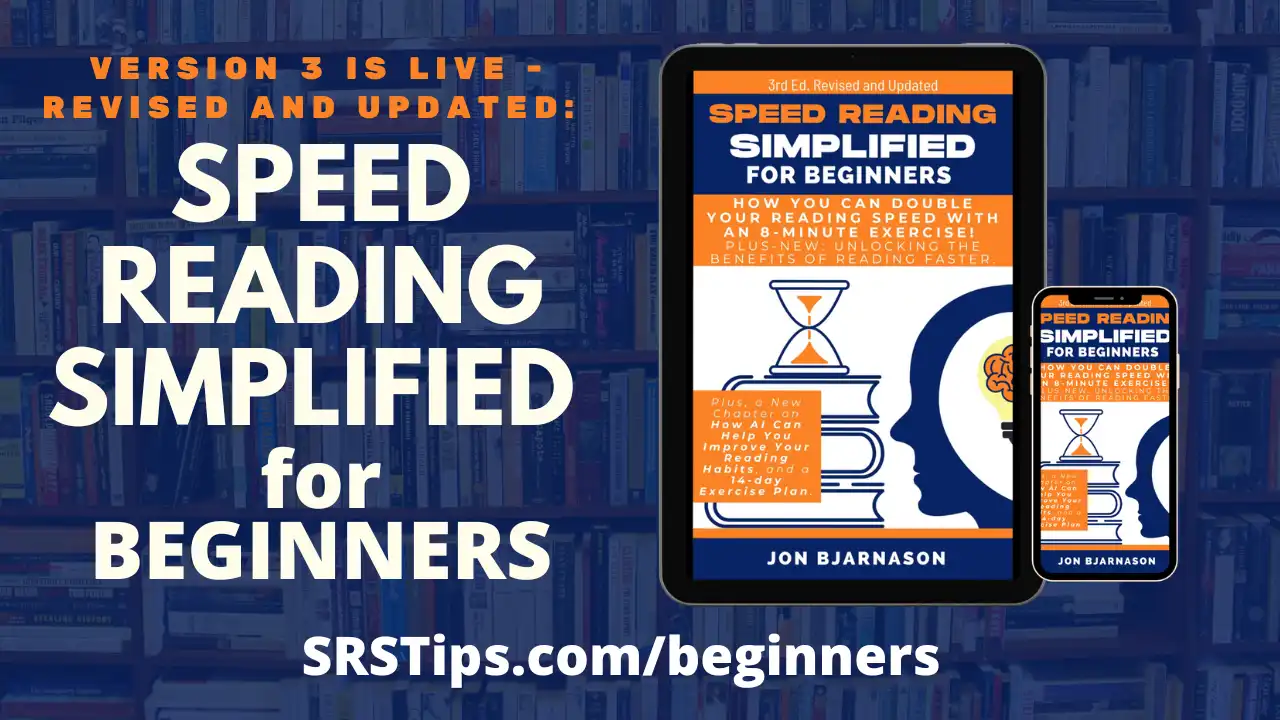
Speed Reading Simplified for Beginners:
How You Can Double Your Reading Speed With an 8 Minute Exercise!
- Along with 7 Bad Reading Habits & 7 Common Misconceptions That People Have About Reading.
>> Available on AMAZON!FAQ: Frequently Asked Questions
Q: What is the 5-Minute SRS Reading Diagnostic?
A: The 5-Minute SRS Reading Diagnostic™ is a short, free reading-habits assessment that produces a personalised reading profile in about five minutes. It asks twelve questions across the dimensions that determine reading performance — focus, retention, reading speed perception, comprehension, fatigue, and reading load — and identifies which of four reader profiles best describes your current reading life. At the end, you receive a clear recommendation for the right next step based on your specific profile, ranging from free reading resources to structured coaching programmes.
Q: How long does the diagnostic take?
A: Five minutes is the typical completion time. Twelve questions in total: eight short multiple-choice questions about your reading habits, two about your situation (your current life stage and age range), one open question where you describe your biggest reading challenge in your own words, and an optional email field if you would like a more detailed written follow-up sent to you. Most respondents finish in three to five minutes.
Q: What does the diagnostic measure?
A: The diagnostic measures eight specific dimensions of reading performance: how often you regress (eyes going back over sentences you have already read), how your focus behaves during sustained reading, how the volume of reading you face feels to you, how much of what you read stays with you a week later, whether your reading load has cost you something concrete recently, how fatigued you feel after extended reading, how clearly you can articulate what you have read to others, and how much unread material has accumulated that you genuinely intend to get to. Each answer contributes to your cumulative reading profile.
Q: Who is the diagnostic for?
A: The diagnostic is built for anyone whose reading is part of how they work, study, or pursue their interests. That includes students at any level, working professionals, executives and business owners, lifelong learners, and readers reading for personal development. The four reader profiles produced by the diagnostic — The Steady Reader, The Pressured Reader, The Strained Reader, and The Overloaded Reader — describe distinct relationships with reading load and reading capability, and the recommended next step adapts to which profile you receive.
Q: What are the four reader profiles?
A: The Steady Reader has mild reading friction and reads in good working order. The Pressured Reader has moderate friction, where reading is functional but the system is starting to show strain. The Strained Reader carries substantial friction across multiple dimensions, where reading is under real strain and structured intervention produces the most visible change. The Overloaded Reader has high friction across most dimensions, where reading has become significantly overloaded and the reading system has not been designed for the load it is now carrying. Each profile receives a specific recommendation for the appropriate next step.
Q: Is the diagnostic free?
A: Yes. The 5-Minute SRS Reading Diagnostic™ itself is completely free and takes about five minutes to complete. You receive your reading profile and your personalised next-step recommendation immediately on completion. If you choose to leave your email address at the end, you also receive a more detailed written follow-up explaining your profile in more depth and pointing you toward specific resources. Email is optional — you can complete the diagnostic and receive your profile without leaving any contact information.
Q: What is Speed Reading Simplified?
A: Speed Reading Simplified is a reading-improvement resource and coaching practice run by Jon Bjarnason, with twenty-one years of experience teaching speed reading, study technique, and time management. Speed Reading Simplified offers free reading resources, a structured ten-day Starter Kit course, and one-on-one coaching programmes ranging from foundational reading habits through to executive-level reading performance. The 5-Minute SRS Reading Diagnostic™ helps visitors understand their reading profile and find the right starting point in the Speed Reading Simplified ecosystem.
Q: What happens after I complete the diagnostic?
A: Once you finish the twelve questions, the diagnostic shows you your reading profile and recommends the most appropriate next step from the Speed Reading Simplified ecosystem — ranging from free reading resources to coaching programmes, depending on your profile. If you provided an email address, you also receive a more detailed written follow-up over the next day or two, with specific suggestions tailored to your answers. You can reply directly to that email if anything resonates or misses, and Jon reads and responds personally.